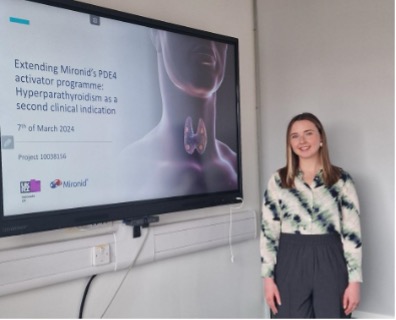
Mironid, a biopharmaceutical company developing small molecule therapeutics for the treatment of Autosomal Dominant Polycystic Kidney Disease (ADPKD), a serious hereditary kidney disease, has successfully completed a project funded by an Innovate UK (IUK) Biomedical Catalyst grant. The project, titled “Extending Mironid’s PDE4 activator programme: Hyperparathyroidism as a second clinical indication,” commenced on March 1st, 2023, and concluded on February 29th, 2024. The primary objective of this project was to investigate Mironid’s proprietary LoAc® molecules for their potential to modulate parathyroid signalling and manage hyperparathyroidism (HPT), an endocrine disorder characterized by elevated levels of parathyroid hormone (PTH) and excessive PTH signalling.
On March 7th, 2024, a successful project close-out meeting was held, presented by one of our Biology Research Scientists, Caitlin Moore, and attended by Mironid’s Julia Adam, David Henderson, Adele Rowley, and Neil Wilkie, and the IUK Monitoring Officer, Kesorn Pechrach, as well as Carys Banks, the IUK Impact and Performance manager. During the meeting, the team presented the overall aims, achievements, and next steps.
The aim of this project was to deliver a comprehensive data package to support development candidate nomination for LoAc® in HPT. Over the course of the 12-month project, LoAc® molecules were extensively evaluated for their ability to mitigate heightened parathyroid signalling and thus for their potential utility in managing HPT. The project’s success significantly strengthens the value proposition behind LoAc® for HPT and Mironid looks forward to leveraging these findings towards IND-enabling studies and clinical evaluation.
Hyperparathyroidism is characterized by elevated levels of circulating PTH. PTH acts by binding to the parathyroid hormone 1 receptor (PTH1R), which couples to the stimulatory GTP binding protein Gαs, resulting in the synthesis and mobilisation of cyclic AMP (cAMP). LoAc® compounds activate long-form PDE4 isoforms, thereby suppressing localised cAMP signalling by enhancing cAMP degradation. By directly targeting this central mediator of PTH signalling, LoAc® compounds are poised to help manage the metabolic imbalances driven by excessive levels of circulating PTH.
“We are thrilled with the successful completion of this project and the promising results obtained,” said Dr. David Henderson, Head of Biology at Mironid. “The data generated through this Innovate UK grant has significantly strengthened our confidence in the potential of LoAc® for the treatment of hyperparathyroidism. We look forward to advancing our research and progressing a LoAc® molecule into clinical evaluation.”